
International Marketing
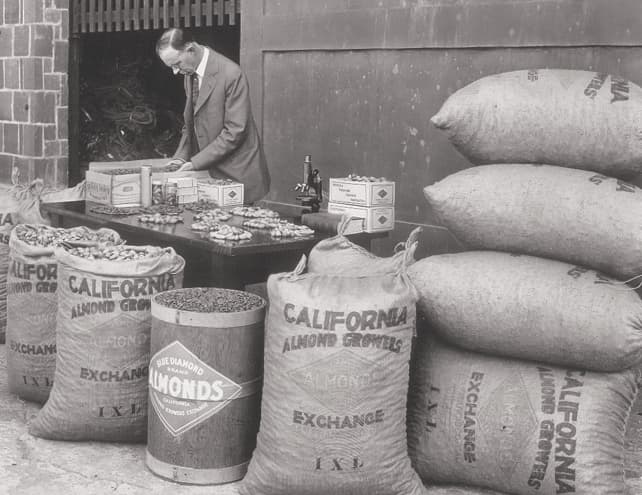
![]() The Blue Diamond plant in 1914. |
In 1910, almonds were a minor crop, a specialty crop, even a novelty in California. But growers saw possibilities. They had dreams and they pursued success through their cooperative, the California Almond Grower's Exchange, now Blue Diamond Growers.
T. C. Tucker, manager of Blue Diamond, paid regular visits to East Coast markets to drum up sales of California almonds. He struggled against low-priced imported almonds from Spain, Italy, and Greece, but steadily gained ground. Interruptions in imports during World Wars I and II helped California growers become established in U.S. markets but a flood of cheap imports following each war undercut their market. Blue Diamond continued to work with the U.S. government to obtain protective tariffs to level the playing field. Success was slow in coming.
Meanwhile, as California growers developed their orchards and supplies grew, Blue Diamond looked to foreign markets as potential customers for California's sweeter, higher quality product. Tucker began scouting European markets in 1916, but World War I put his plans on hold.
A decade later, Tucker's international efforts paid off. His representative completed a tour of the Mediterranean region creating contacts that provided supply intelligence and potential sales outlets.
![]() T.C. Tucker with Harry S. Maddox, California State Director of Markets. July 1922. |
The stock market crash in 1929 hit Germany, one of the European almond industry's most important markets, particularly hard. Italian shippers, who depended heavily on the German market, diverted their large crop of shelled almonds to Spain and the United States, severely weakening those markets. Blue Diamond's sketchy data on European production and sales led to the co-op pricing its shelled almonds too high and the market slid out from under it. This incident convinced Blue Diamond leaders that closer monitoring of Europe with an eye to future markets there had to be part of their long-term strategy.
In 1936, D.R. Bailey was named manager of Blue Diamond. He faced difficult times. The world economy remained mired in depression. Foreign nuts, produced by poorly paid peasants, flooded the U.S. market at bargain prices, knocking the floor out from under the co-op's best pricing efforts. And the Roosevelt administration would not consider a tariff.
Bailey saw exports as a potential safety valve to keep domestic markets free from unmanageable surpluses. The good reception received by a small amount of California almonds sold abroad in 1938 encouraged him. The trade reported that the buyers of those shipments preferred the California nuts because of the soft shell and high quality.
A large crop in 1939 supported international marketing efforts. Prices, the lowest since 1934, along with a declaration of war in Europe, stimulated buying. The outbreak of hostilities abroad caused the Canadian market to look to California for its needs, which resulted in the largest-ever volume of orders from Canadian buyers.
![]() The Exchange developed a close working relationship with government officials early on and has maintained that critical link through the years. D. R. Bailey, manager of the Exchange, is shown welcoming California Governor Earl Warren to the association's 35th annual meeting in November 1945. |
As Blue Diamond entered another uncertain post-war economy, it led the fight to take the California almond industry from a small specialty crop and minor factor in the world nut trade to a new status as a high-profile player in Washington, D.C. and leader of the international almond market. In time, California almonds would replace foreign almonds as the primary source for U.S. buyers. And California almonds would turn the tables on foreign producers by becoming the almonds of choice in foreign markets.
But Blue Diamond had to fight for every inch of ground. While Blue Diamond and others pressured the U.S.D.A., Congress, and President Truman for protection and fair play, 13 million pounds of foreign almonds flooded the U.S. market. Bailey and Jack Axer, export manager, traveled to Italy and Sicily to determine if the Italians had dumped almonds on the U.S. market.
Finding that Italian growers had been paid more per pound for their almonds than those almonds had been sold for to U.S. buyers, Bailey appealed to the U.S. Customs Service for countervailing duties. His request went nowhere. Finally, in December 1951, President Truman accepted the Tariff Commission's recommendation that an import quota be established for almonds. Blue Diamond had led the fight and won relief for all California almond producers.
With an eye to learning more about foreign production and marketing - and future sales opportunities - Bailey invited leading Spanish almond exporters to Barcelona, Spain in April 1955, and Italian exporters to Bari, Italy the following month. He proposed to talk about world almond marketing conditions and develop a basis for better understanding and cooperation between the world's three leading almond producing regions. He hoped to encourage an exchange of production and marketing information, and to create a better understanding of the California industry's role in the domestic and world markets. He also hoped to collect data to support the need for U.S. import quotas.
The sessions were successful, and Bailey and Axer repeated the sessions annually through 1956. They extended their survey to India, Iran and Turkey, which produced a variety of nuts, including almonds. Soon, Blue Diamond was shipping California almonds to European and Middle Eastern markets.
A sales representative was appointed in Asia, where Bailey believed "an excellent potential for California almonds now exists and can be expanded in that part of the world." The scope of Blue Diamond's activities was becoming global, in keeping with California's ability to produce an exportable surplus of high quality almonds.
Axer set out to expand sales worldwide. Realizing that to do so would require years of preparation and relationship building, he started with Canada, then Mexico, the United Kingdom and Germany. He recalled, "In Europe, our work was cut out for us. Italian, Spanish and Portuguese almonds had been the only almonds Europeans knew. West Germany was the number one per capita consumer of almonds and Hamburg, Germany, was the center of the almond trade in Europe."
Axer asked European manufacturers to use Blue Diamond almonds in samples and asked Europeans to taste the product. When California almonds were compared to Mediterranean almonds, European buyers were increasingly choosing California nuts. Axer extended his sales efforts to the Middle East and Africa. He made his first trip to Japan in 1959 where, 20 years later, more than 30 million pounds would be bought annually.
![]() The Exchange's globetrotting sales efforts attracted the attention of the federal government and earned a prestigious recognition from the highest level of the Johnson Administration. At the 56th Annual Meeting, Jack Axer accepted on behalf of the Exchange the President's "E" Award for exports. |
Axer predicted that foreign sales would become even more important with anticipated large increases in almond production. In markets where almonds were already known, the emphasis was on new uses and building additional sales, rather than simply replacing Mediterranean almonds. Swedish buyers, for example, were interested in manufactured items, such as blanched, split and other cut almonds. Australian customers were placing repeat orders for the famous Smokehouse and Onion-Garlic flavored almonds, and a firm in Poland was buying Smokehouse as well.
In 1966, California handlers sold some 30 percent of the crop to foreign customers. Exports had become a major part of the industry's business. In the spring of 1968, Blue Diamond sold the first California almonds, 600 cases of Barbeque flavor snack almonds, to Russia. The Soviets quickly reordered a larger quantity, launching what grew into a substantial repeat business.
In an effort to keep export growth on the fast track, Blue Diamond opened a market development office in Tokyo. "Japan, already one of our biggest export customers, continues to offer the greatest growth potential," commented Axer.
During the energy crisis in 1973, rapidly increasing fuel prices drove up manufacturing and distribution costs, creating shortages of critical materials. Soaring prices of cocoa, sugar and milk caused chocolate manufacturers in the United States, United Kingdom and Japan to curtail chocolate bar production and, as a result, their purchases of almonds. The chocolate industry had long been the industry's largest user of almonds. The following crop brought in 60 percent more nuts in handlers' warehouses than the previous year. Blue Diamond reduced prices to stimulate consumption. Buyers in Europe and Japan immediately responded, buying carloads of Blue Diamond almonds.
![]() The big crop that everyone had been expecting arrived in 1974. This is the Salida plant facility |
Good news arrived in 1977. In April, U.S. government officials, at Blue Diamonds' request, obtained lower import tariffs on California almonds shipped to India, making California almonds competitive in the second most populous country in the world. Shipments to that country shot up to a million pounds. Steve Easter, Blue Diamond's government affairs representative, who had worked long and hard to makes his case for lower tariffs, had finally won.
In 1979, at 376 million pounds, California's crop became the largest in history and almonds the state's leading food export. With crops increasing in size and world demand growing, Blue Diamond representatives expanded their efforts to establish new sales outlets worldwide. Vice president of exports Walter Payne established a strong relationship with China. The Chinese government placed orders with the Exchange totaling some 30 tons of almonds, the first of many to come.
Blue Diamond continued to keep the interest of the California almond industry in front of U.S. trade negotiators and legislators. The cooperative helped maintain current U.S. tariffs on almond imports, and was instrumental in obtaining government matching funds for promoting California almonds in foreign markets.
In the early to mid 1980s, foreign currencies dropped lower in value compared to the U.S. dollar causing decreased demand for California almonds in export markets while crops continued to swell. Blue Diamond turned its attention to the domestic market while it waited for the dollar to weaken abroad. Blue Diamond snack almonds were introduced in Western Europe early in the 1980s.
![]() India began to emerge as an important new market for California Almonds in the 1980s. |
After years of educating lawmakers and trade negotiators about the value of increased almond exports to the U.S. economy, Steve Easter was able to report in 1986 that the European Economic Community had agreed to reduce the almond duty from 7 percent to 2 percent on the first 99 million pounds entering the EEC each year. Blue Diamond opportunities in Europe suddenly grew larger.
Export sales got another boost in 1986 from two new funding sources for promotion of agricultural products in overseas markets. Matching funds were provided by the California Department of Food and Agriculture under a new California Export Incentive program and by the Foreign Agricultural Service's Targeted Export Incentive Program. Blue Diamond applied for and received matching funds for promotional work in Canada, Japan, Korea, Asia, the Middle East, Europe and Scandinavia.
As innovation and expert technical assistance strengthened in the 1990's, Blue Diamond emphasized new, high-value almond products that expanded worldwide consumption. Dozens of new snack items tempted Japanese customers - crackers, cookies, truffles, snack "sticks" and chocolate bars proliferated, some of which were developed and sold by Blue Diamond in Japan. Korean consumers enjoyed almond biscuits, cookies, candy bars and cereals.
In Europe, manufacturers turned out dozens of variations of almond marzipan bars, cereals, fruitcakes, candy coated almonds, spread and other confections. In the United States, as well as abroad, major food manufacturers jumped on the almond bandwagon as good news about the nutritional value and health enhancing properties of almonds spilled out of research laboratories around the world. Demand for California almonds soared, climbing at more than 9 percent annually.
In 2001, under new leadership and a strong focus on strategic planning by the board of directors and management, Blue Diamond began leveraging the power of the brand to expand sales worldwide. The cooperative saw growth opportunities in the rapidly expanding middle class populations in developing countries such as Russia, China, India, Brazil and in Southeast Asia. With Blue Diamond representatives knocking on doors in all those places and more, exports grew rapidly, absorbing new tonnage from record-size crops in California.
To keep California almonds flowing into eager markets around the world, Blue Diamond representatives continued to lead on trade issues, working closely with the U.S. Trade Representative, Congress and other government officials to lower tariffs and keep them low, and remove trade barriers in markets such as India and China.
By 2004, despite back-to-back record crops over one billion pounds, rising global demand exceeded supply, driving grower prices to new highs and bringing welcome prosperity to an industry that had suffered from falling prices in the late 1990s and early 2000s.
![]() Blue Diamond almonds being delivered in Old Delhi, India. |
As the decade drew to a close, export sales helped set new shipment records for the industry as growers delivered consecutive billion-pound crops. In 2008, industry sales to China shot up 115 percent, Middle East sales jumped 51 percent, Eastern Europe rose 32 percent, Western Europe was up 24 percent and India increased by 19 percent. The industry had never seen better times. But the euphoria ended abruptly with the financial crisis of 2008-2009. Buyers suddenly pulled back, demand slumped while at the same time the largest crop on record filled warehouses. Prices dropped. Long faces turned cheery by season's end, however, as international demand regained its vigor, sending the market on a buying spree that set a new shipment record of 1.39 billion pounds and a grower return among the top five in history.
Blue Diamond brand products joined the highly successful ingredient business in global markets in 2008. Long recognized for their excellence and preferred by bakers, candy makers and other food manufacturers, Blue Diamond's wide range of processed ingredients had been leaders in Europe, Asia and elsewhere for decades. Now branded products, such as Roasted Salted, Wasabi & Soy Sauce and Jalapeno Smokehouse snack nuts, are appearing on retail shelves in Europe, another example of Blue Diamond leveraging the power of its world famous brand for incremental sales and margins for growers. Meanwhile, Blue Diamond introduced four new flavors of oil-roasted almonds for use as ingredients in snacks and trail mixes.
By the end of the decade, Blue Diamond's multi-pronged product development, brand leveraging, market-segmenting strategy was paying off in rapid growth in sales volume and higher returns to growers. Product innovation, skillful marketing and compelling product promotion worldwide, in both ingredient and retail sales, continue to drive Blue Diamond to new heights as the best marketing alternative for California almond growers.